Investigation of natural RIN4 variants reveals a motif crucial for function and provides an opportunity to broaden NLR regulation specificity
- Author
- Kee Hoon Sohn
- Journal
- Plant J . 2022 Apr;110(1):58-70.
- Date of Publication
- 2022-04
- Original link
Abstract
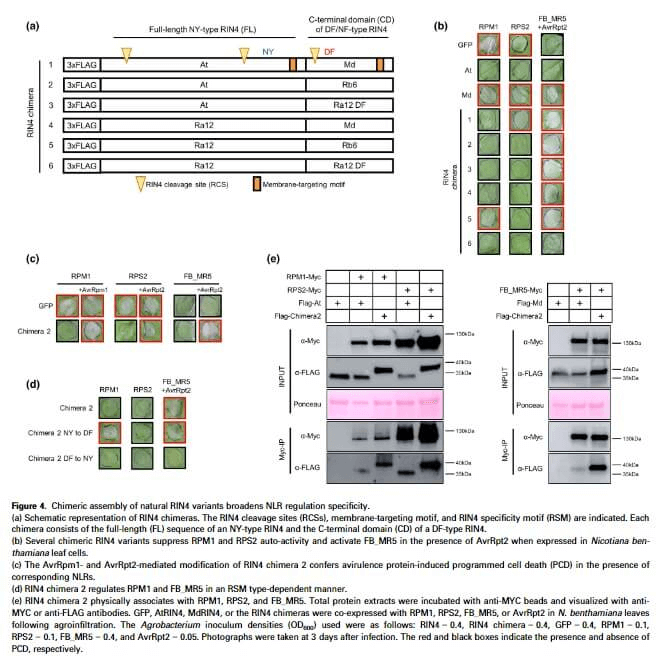
Multiple bacterial effectors target RPM1-INTERACTING PROTEIN4 (RIN4), the biochemical modifications of which are recognized by several plant nucleotide-binding and leucine-rich repeat immune receptor (NLR) proteins. Recently, a comparative study of Arabidopsis and apple (Malus domestica) RIN4s revealed that the RIN4 specificity motif (RSM) is critical for NLR regulation. Here, we investigated the extent to which the RSM contributes to the functions of natural RIN4 variants. Functional analysis of 33 natural RIN4 variants from 28 plant species showed that the RSM is generally required yet sometimes dispensable for the RIN4-mediated suppression of NLR auto-activity or effector-triggered NLR activation. Association analysis of the sequences and fire blight resistance gene originating from Malus × robusta 5 (FB_MR5) activation functions of the natural RIN4 variants revealed H167 to be an indispensable residue for RIN4 function in the regulation of NLRs. None of the tested natural RIN4 variants could suppress RESISTANCE TO PSEUDOMONAS SYRINGAE PV. MACULICOLA1 (RPM1) auto-activity and activate FB_MR5. To engineer RIN4 to carry broader NLR compatibility, we generated chimeric RIN4 proteins, several of which could regulate RPM1, RESISTANT TO PSEUDOMONAS SYRINGAE2 (RPS2), and FB_MR5. We propose that the intrinsically disordered nature of RIN4 provides a flexible platform to broaden pathogen recognition specificity by establishing compatibility with otherwise incompatible NLRs.
Image