Enzyme activity engineering based on sequence co-evolution analysis
- Author
- Sanguk Kim
- Journal
- Metab Eng . 2022 Sep 13;74:49-60
- Date of Publication
- 2022-09
- Original link
Abstract
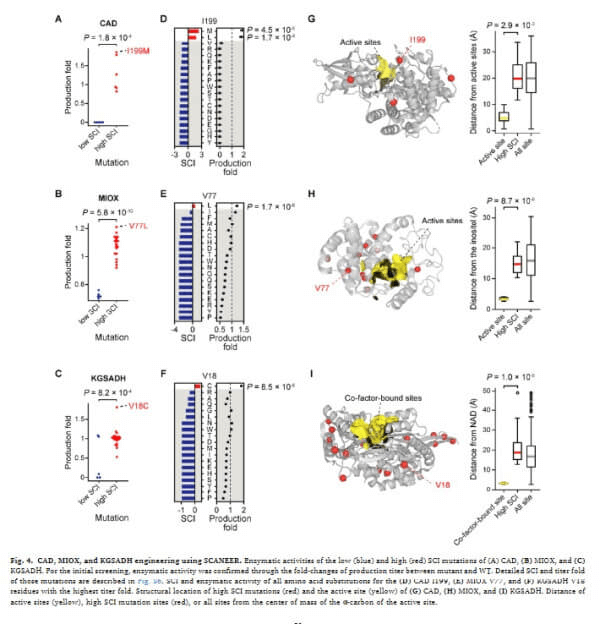
The utility of engineering enzyme activity is expanding with the development of biotechnology. Conventional methods have limited applicability as they require high-throughput screening or three-dimensional structures to direct target residues of activity control. An alternative method uses sequence evolution of natural selection. A repertoire of mutations was selected for fine-tuning enzyme activities to adapt to varying environments during the evolution. Here, we devised a strategy called sequence co-evolutionary analysis to control the efficiency of enzyme reactions (SCANEER), which scans the evolution of protein sequences and direct mutation strategy to improve enzyme activity. We hypothesized that amino acid pairs for various enzyme activity were encoded in the evolutionary history of protein sequences, whereas loss-of-function mutations were avoided since those are depleted during the evolution. SCANEER successfully predicted the enzyme activities of beta-lactamase and aminoglycoside 3'-phosphotransferase. SCANEER was further experimentally validated to control the activities of three different enzymes of great interest in chemical production: cis-aconitate decarboxylase, α-ketoglutaric semialdehyde dehydrogenase, and inositol oxygenase. Activity-enhancing mutations that improve substrate-binding affinity or turnover rate were found at sites distal from known active sites or ligand-binding pockets. We provide SCANEER to control desired enzyme activity through a user-friendly webserver.
Image