Bone marrow CX3CR1+ mononuclear cells relay a systemic microbiota signal to control hematopoietic progenitors in mice.
- Author
- Seung-Woo Lee
- Journal
- BLOOD, 134(16):1312-1322. doi: 10.1182/blood.2019000495
- Date of Publication
- 2019-10
Abstract
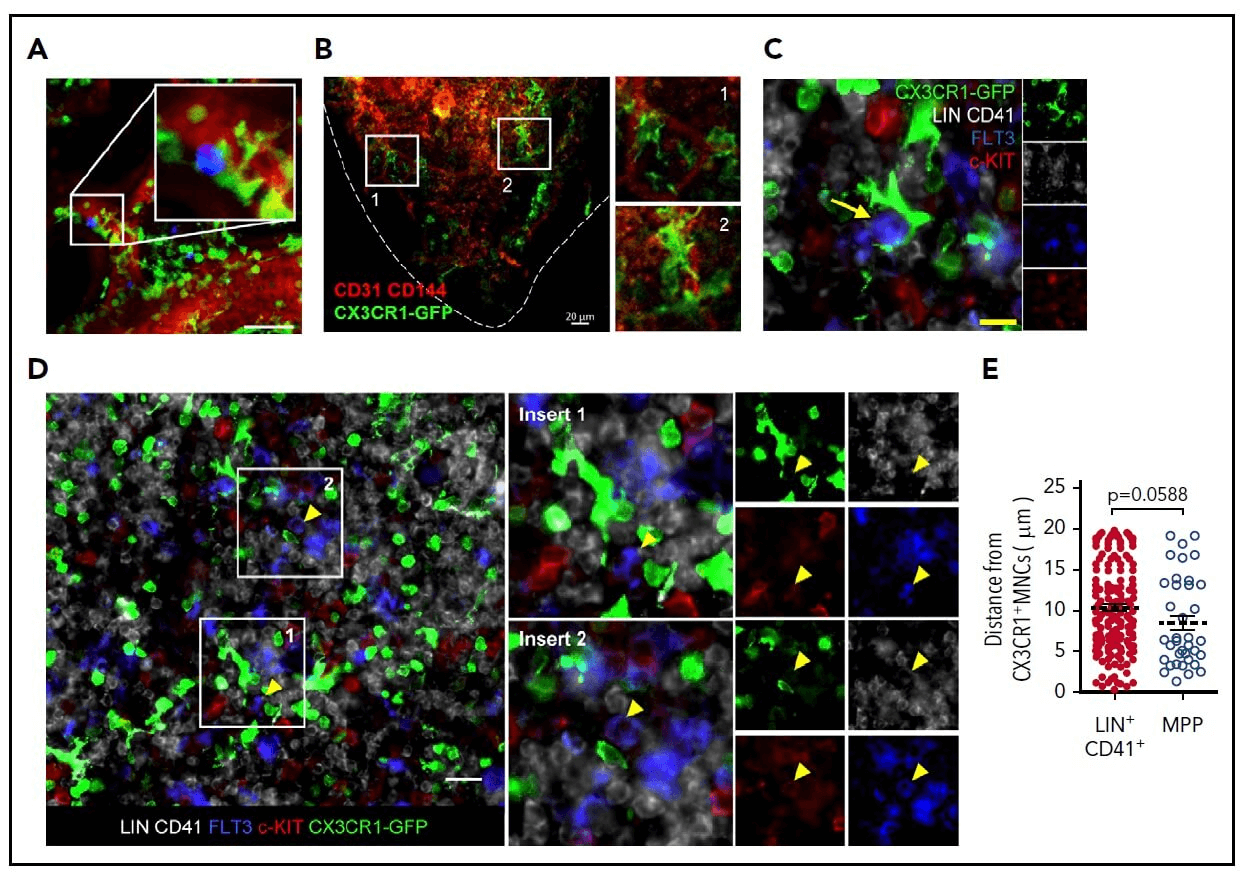
The microbiota regulate hematopoiesis in the bone marrow (BM); however, the detailed mechanisms remain largely unknown. In this study, we explored how microbiota-derived molecules (MDMs) were transferred to the BM and sensed by the local immune cells to control hematopoiesis under steady-state conditions. We reveal that MDMs, including bacterial DNA (bDNA), reach the BM via systemic blood circulation and are captured by CX3CR11 mononuclear cells (MNCs). CX3CR11 MNCs sense MDMs via endolysosomal Tolllike receptors (TLRs) to produce inflammatory cytokines, which control the basal expansion of hematopoietic progenitors, but not hematopoietic stem cells, and their differentiation potential toward myeloid lineages. CX3CR11 MNCs colocate with hematopoietic progenitors at the perivascular region, and the depletion of CX3CR11 MNCs impedes bDNA influx into the BM. Moreover, the abrogation of TLR pathways in CX3CR11 MNCs abolished the microbiota effect on hematopoiesis. These studies demonstrate that systemic MDMs control BM hematopoiesis by producing CX3CR11 MNC–mediated cytokines in the steadystate.
Image