Molecular Mechanism of the Specificity of Protein Import into Chloroplasts and Mitochondria in Plant Cells.
- Author
- Inhwan Hwang
- Journal
- Molecular Plant, 12(7):951-966. doi: 10.1016/j.molp.2019.03.003
- Date of Publication
- 2019-07
Abstract
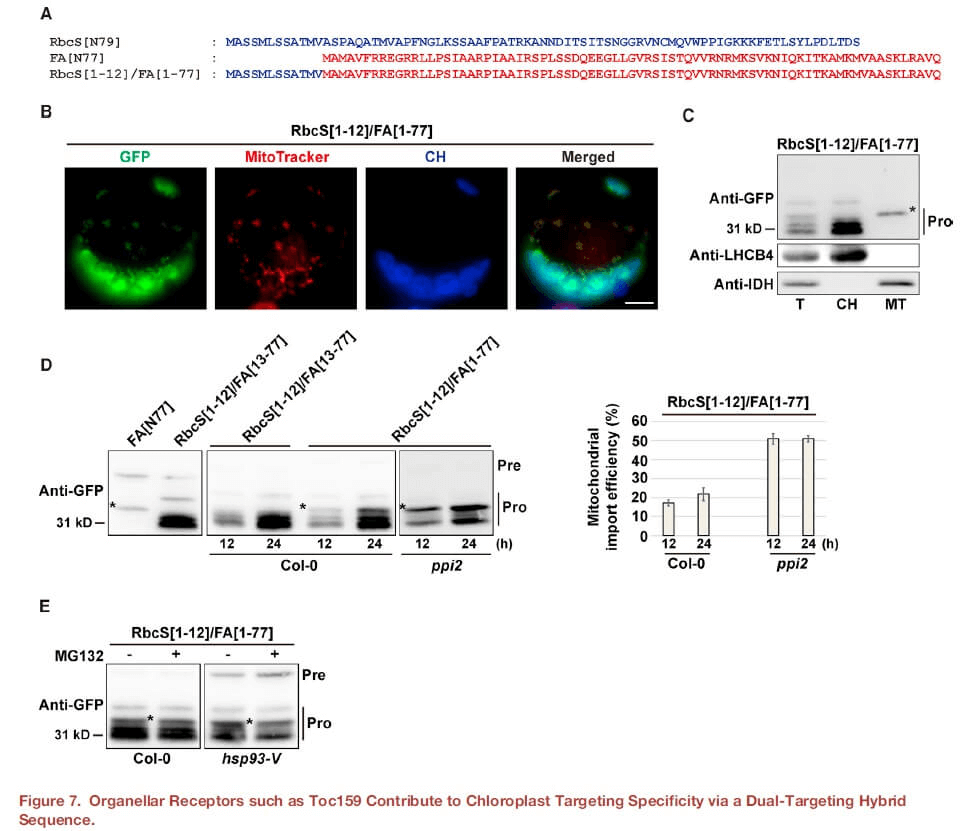
Plants possess both types of endosymbiotic organelles, chloroplasts and mitochondria. Transit peptides and presequences function as signal sequences for specific import into chloroplasts and mitochondria, respectively. However, how these highly similar signal sequences confer the protein import specificity remains elusive. Here, we show that mitochondrial- or chloroplast-specific import involves two distinct steps, specificity determination and translocation across envelopes, which are mediated by the N-terminal regions and functionally interchangeable C-terminal regions, respectively, of transit peptides and presequences. A domain harboring multiple-arginine and hydrophobic sequence motifs in the N-terminal regions of presequences was identified as the mitochondrial specificity factor. The presence of this domain and the absence of arginine residues in the N-terminal regions of otherwise common targeting signals confers specificity of protein import into mitochondria and chloroplasts, respectively. AtToc159, a chloroplast import receptor, also contributes to determining chloroplast import specificity. We propose that common ancestral sequences were functionalized into mitochondrial- and chloroplast-specific signal sequences by the presence and absence, respectively, of multiple-arginine and hydrophobic sequence motifs in the N-terminal region.
Image