Arabidopsis BAG1 Functions as a Cofactor in Hsc70-Mediated Proteasomal Degradation of Unimported Plastid Proteins
2017-10-17
2989
- Author
- Inhwan Hwang
- Journal
- Mol Plant. 2016 Oct 10;9(10):1428-1431. doi: 10.1016/j.molp.2016.06.005.
- Date of Publication
- 2016-10
Abstract
Eliminating misfolded or mistargeted proteins is crucial for cell
viability because these proteins accumulate as non-specific
aggregates, which can be toxic to the cell (Lee et al., 2009;
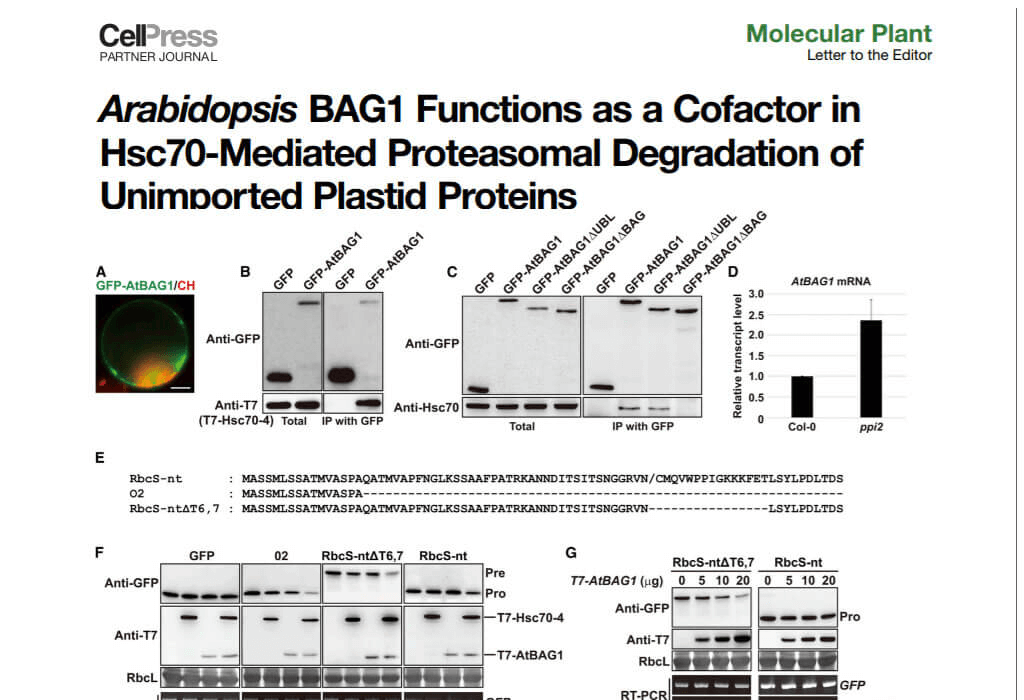
Sroka et al., 2009). Previously, we have shown that in ppi2
(plastid protein import 2) mutant plants, the transcript levels of
Hsc70-4 (one isoform of the Hsc70 family) and CHIP (an E3
ligase) were highly upregulated, which ultimately plays crucial
roles in proteasomal degradation of unimported plastid proteins
(Lee et al., 2009). We also found that, along with those of
Hsc70-4 and CHIP, the transcript level of AtBAG1 (Arabidopsis
thaliana Bcl2-associated athanogene 1) in the ppi2 mutant was
2.38-fold higher than that in the wild-type (Lee et al., 2009). In
mammalian cells, BAG proteins play multiple roles in protein
homeostasis, especially as nucleotide exchange factors of
Hsc70, thereby contributing to protein quality control (Alberti
et al., 2003; Doukhanina et al., 2006). Therefore, in this study,
we examined the role of AtBAG in Hsc70-4-mediated protein
quality control in the cytosol
viability because these proteins accumulate as non-specific
aggregates, which can be toxic to the cell (Lee et al., 2009;
Sroka et al., 2009). Previously, we have shown that in ppi2
(plastid protein import 2) mutant plants, the transcript levels of
Hsc70-4 (one isoform of the Hsc70 family) and CHIP (an E3
ligase) were highly upregulated, which ultimately plays crucial
roles in proteasomal degradation of unimported plastid proteins
(Lee et al., 2009). We also found that, along with those of
Hsc70-4 and CHIP, the transcript level of AtBAG1 (Arabidopsis
thaliana Bcl2-associated athanogene 1) in the ppi2 mutant was
2.38-fold higher than that in the wild-type (Lee et al., 2009). In
mammalian cells, BAG proteins play multiple roles in protein
homeostasis, especially as nucleotide exchange factors of
Hsc70, thereby contributing to protein quality control (Alberti
et al., 2003; Doukhanina et al., 2006). Therefore, in this study,
we examined the role of AtBAG in Hsc70-4-mediated protein
quality control in the cytosol
Image