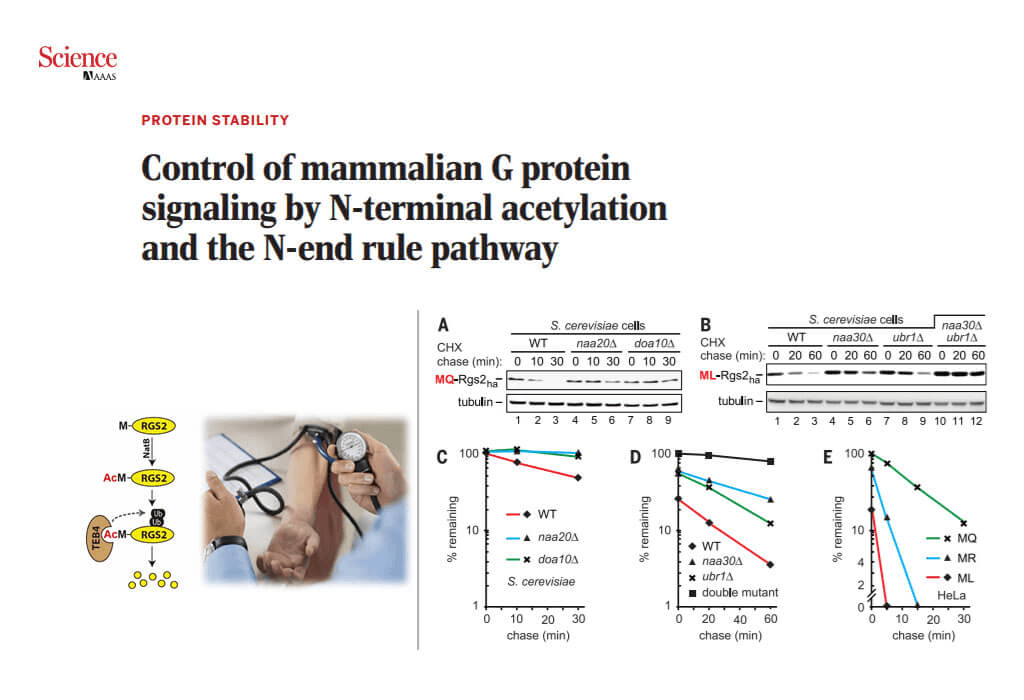
Control of mammalian G protein signaling by N-terminal acetylation and the N-end rule pathway
2017-10-17
2619
- Author
- Cheol-Sang Hwang
- Journal
- Science, 347(6227):1249-1252
- Date of Publication
- 2015-03
Abstract
Rgs2, a regulator of G proteins, lowers blood pressure by decreasing signaling through Gαq. Human patients expressing Met-Leu-Rgs2 (ML-Rgs2) or Met-Arg-Rgs2 (MR-Rgs2) are hypertensive relative to people expressing wild-type Met-Gln-Rgs2 (MQ-Rgs2). We found that wild-type MQ-Rgs2 and its mutant, MR-Rgs2, were destroyed by the Ac/N-end rule pathway, which recognizes N(α)-terminally acetylated (Nt-acetylated) proteins. The shortest-lived mutant, ML-Rgs2, was targeted by both the Ac/N-end rule and Arg/N-end rule pathways. The latter pathway recognizes unacetylated N-terminal residues. Thus, the Nt-acetylated Ac-MX-Rgs2 (X = Arg, Gln, Leu) proteins are specific substrates of the mammalian Ac/N-end rule pathway. Furthermore, the Ac/N-degron of Ac-MQ-Rgs2 was conditional, and Teb4, an endoplasmic reticulum (ER) membrane-embedded ubiquitin ligase, was able to regulate G protein signaling by targeting Ac-MX-Rgs2 proteins for degradation through their N(α)-terminal acetyl group.
Image