A conserved translational repression module buffers sugar-inducible root vascular proliferation
- Author
- Ildoo Hwang
- Journal
- Molecular Plant
- Date of Publication
- 2026-04
Abstract
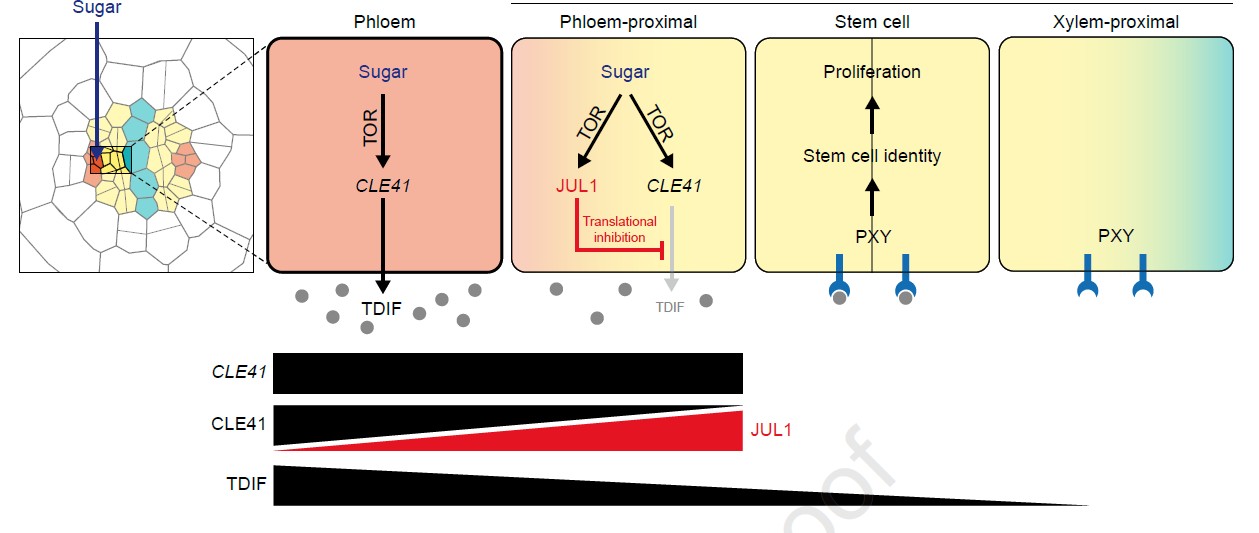
Balancing vascular proliferation with sugar availability is essential for optimal carbon allocation; however, the molecular signaling networks integrating sugar status into vascular development remains unclear. Here, using histological, genetic, and pharmacological analyses in the Arabidopsis root, we demonstrate that sugar acts as an instructive signal to drive vascular proliferation. Sugar primes cell proliferation and the gene regulatory networks required for vascular development through the TARGET OF RAPAMYCIN (TOR) pathway. We further uncover that this sugar-driven vascular program incorporates a translational repression module comprising the RNA-binding protein JULGI1 (JUL1) and its target, CLAVATA3/ESR-RELATED41 (CLE41) mRNA. This regulation is mediated by a conserved guanine-rich motif in the CLE41 5' UTR, which enables JUL1 binding and imposes a negative feedback regulation on vascular proliferation. Furthermore, phylogenetic and cross-species analyses indicate that the JUL1-CLE41 module is conserved across cambium-bearing plant lineages. Collectively, these findings establish that sugars directly activate vascular growth, while the JUL1-CLE41 module constrains this response to ensure balanced proliferation under sugar-rich conditions. Our work provides a framework for viewing vascular proliferation as a sugar-responsive developmental process buffered by intrinsic regulatory mechanisms to maintain homeostasis, a principle that may underlie the evolutionary refinement of sugar-responsive vascular growth strategies.
Image