Partial in vivo reprogramming enables injury-free intestinal regeneration via autonomous Ptgs1 induction
- Author
- Jong Kyoung Kim
- Journal
- Sci Adv . 2023 Nov 24;9(47):eadi8454
- Date of Publication
- 2023-11
- Original link
Abstract
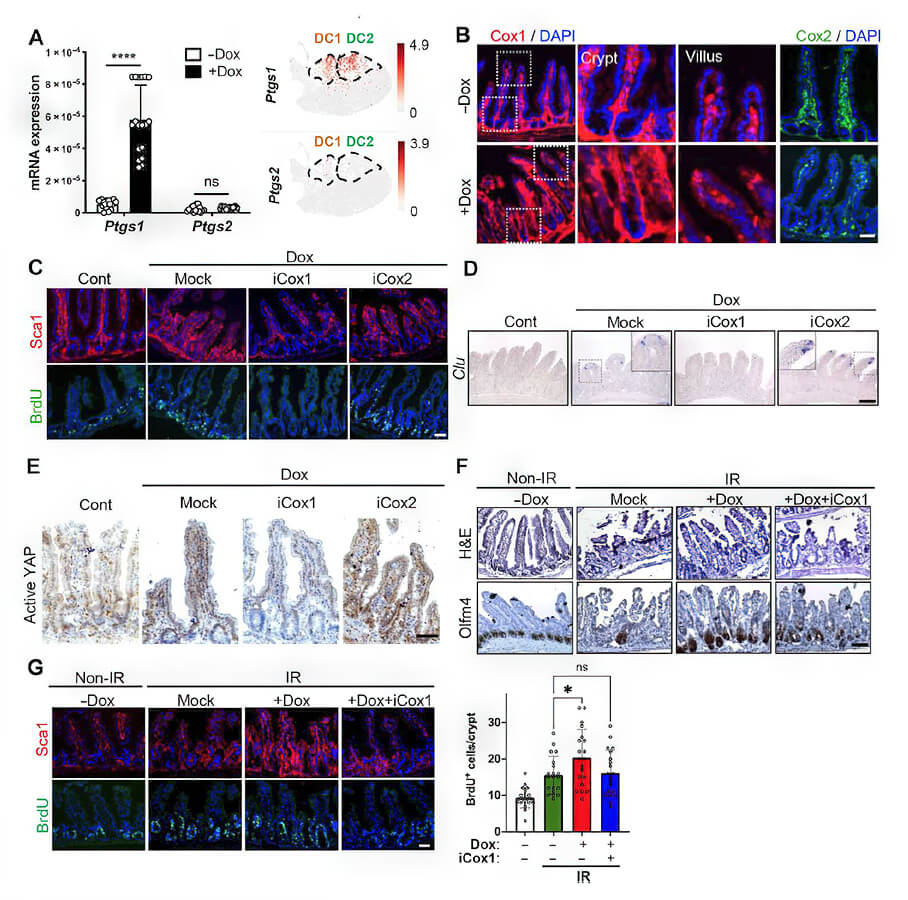
Tissue regeneration after injury involves the dedifferentiation of somatic cells, a natural adaptive reprogramming that leads to the emergence of injury-responsive cells with fetal-like characteristics. However, there is no direct evidence that adaptive reprogramming involves a shared molecular mechanism with direct cellular reprogramming. Here, we induced dedifferentiation of intestinal epithelial cells using OSKM (Oct4, Sox2, Klf4, and c-Myc) in vivo. The OSKM-induced forced dedifferentiation showed similar molecular features of intestinal regeneration, including a transition from homeostatic cell types to injury-responsive-like cell types. These injury-responsive-like cells, sharing gene signatures of revival stem cells and atrophy-induced villus epithelial cells, actively assisted tissue regeneration following damage. In contrast to normal intestinal regeneration involving Ptgs2 induction, the OSKM promotes autonomous production of prostaglandin E2 via epithelial Ptgs1 expression. These results indicate prostaglandin synthesis is a common mechanism for intestinal regeneration but involves a different enzyme when partial reprogramming is applied to the intestinal epithelium.
Image
- 이전글A longitudinal molecular and cellular lung atlas of lethal SARS-CoV-2 infection in K18-hACE2 transgenic mice
- 다음글Mass-produced gram-negative bacterial outer membrane vesicles activate cancer antigen-specific stem-like CD8(+) T cells which enables an effective combination immunotherapy with anti-PD-1