The flip-flop configuration of the PABP-dimer leads to switching of the translation function
- Author
- Sung Key Jang
- Journal
- Nucleic Acids Res . 2022 Jan 11;50(1):306-321.
- Date of Publication
- 2022-01
Abstract
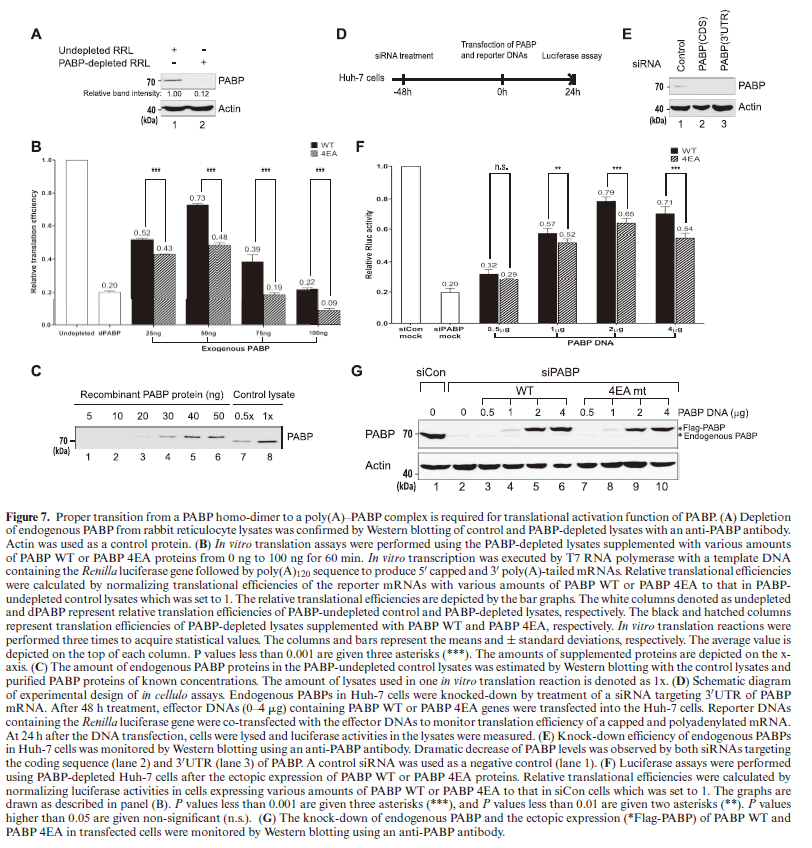
Poly(A)-binding protein (PABP) is a translation initiation factor that interacts with the poly(A) tail of mRNAs. PABP bound to poly(A) stimulates translation by interacting with the eukaryotic initiation factor 4G (eIF4G), which brings the 3' end of an mRNA close to its 5' m7G cap structure through consecutive interactions of the 3'-poly(A)-PABP-eIF4G-eIF4E-5' m7G cap. PABP is a highly abundant translation factor present in considerably larger quantities than mRNA and eIF4G in cells. However, it has not been elucidated how eIF4G, present in limited cellular concentrations, is not sequestered by mRNA-free PABP, present at high cellular concentrations, but associates with PABP complexed with the poly(A) tail of an mRNA. Here, we report that RNA-free PABPs dimerize with a head-to-head type configuration of PABP, which interferes in the interaction between PABP and eIF4G. We identified the domains of PABP responsible for PABP-PABP interaction. Poly(A) RNA was shown to convert the PABP-PABP complex into a poly(A)-PABP complex, with a head-to-tail-type configuration of PABP that facilitates the interaction between PABP and eIF4G. Lastly, we showed that the transition from the PABP dimer to the poly(A)-PABP complex is necessary for the translational activation function.
Image