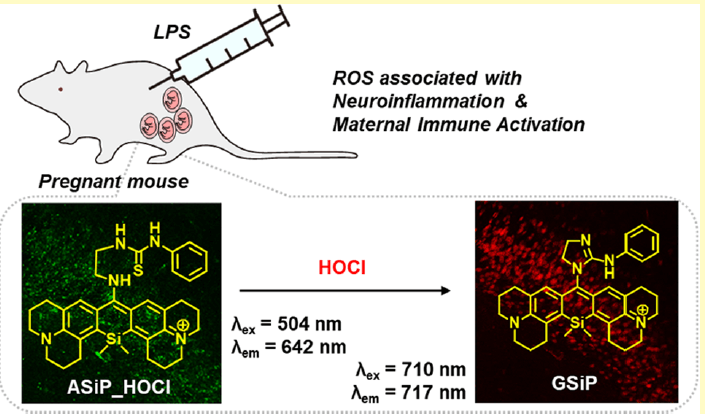
Ratiometric Detection of Hypochlorous Acid in Brain Tissues of Neuroinflammation and Maternal Immune Activation Models with a Deep-Red/Near-Infrared Emitting Probe
- Author
- Sang Ki Park
- Journal
- ACS Sens . 2021 Sep 24;6(9):3253-3261
- Date of Publication
- 2021-09
Abstract
Reactive oxygen species (ROS) produced by an inflammatory response in the brain are associated with various neurological disorders. To investigate ROS-associated neuroinflammatory diseases, fluorescent probes with practicality are in demand. We have investigated hypochlorous acid, an important ROS, in the brain tissues of neuroinflammation and maternal immune activation (MIA) model mice, using a new fluorescent probe. The probe has outstanding features over many known probes, such as providing two bright ratio signals in cells and tissues in deep-red/near-infrared wavelength regions with a large spectral separation, in addition to being strongly fluorescent, photo- and chemo-stable, highly selective and sensitive, fast responding, and biocompatible. We have found that the level of hypochlorous acid in the brain tissue of a neuroinflammatory mouse model was higher (2.7-4.0-fold) compared with that in normal brain tissue. Furthermore, the level of hypochlorous acid in the brain tissue of a MIA mouse model was higher (1.2-1.3-fold) compared with that in the normal brain tissue. The "robust" probe provides a practical tool for studying ROS-associated neurological disorders.
Image