Long-term abscisic acid promotes golden2-like1 degradation through constitutive photomorphogenic 1 in a light intensity-dependent manner to suppress chloroplast development
- Author
- Inhwan Hwang
- Journal
- Plant Cell Environ . 2021 Sep;44(9):3034-3048. doi: 10.1111/pce.14130
- Date of Publication
- 2021-09
Abstract
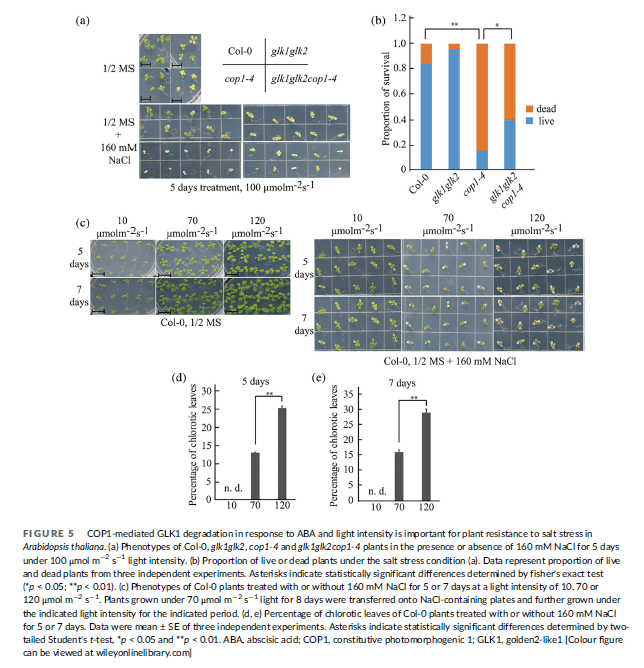
Abiotic stress, a serious threat to plants, occurs for extended periods in nature. Abscisic acid (ABA) plays a critical role in abiotic stress responses in plants. Therefore, stress responses mediated by ABA have been studied extensively, especially in short-term responses. However, long-term stress responses mediated by ABA remain largely unknown. To elucidate the mechanism by which plants respond to prolonged abiotic stress, we used long-term ABA treatment that activates the signalling against abiotic stress such as dehydration and investigated mechanisms underlying the responses. Long-term ABA treatment activates constitutive photomorphogenic 1 (COP1). Active COP1 mediates the ubiquitination of golden2-like1 (GLK1) for degradation, contributing to lowering expression of photosynthesis-associated genes such as glutamyl-tRNA reductase (HEMA1) and protochlorophyllide oxidoreductase A (PORA), resulting in the suppression of chloroplast development. Moreover, COP1 activation and GLK1 degradation upon long-term ABA treatment depend on light intensity. Additionally, plants with COP1 mutation or exposed to higher light intensity were more sensitive to salt stress. Collectively, our results demonstrate that long-term treatment of ABA leads to activation of COP1 in a light intensity-dependent manner for GLK1 degradation to suppress chloroplast development, which we propose to constitute a mechanism of balancing normal growth and stress responses upon the long-term abiotic stress.
Image