The phosphatidylethanolamine-binding protein DTH1 mediates degradation of lipid droplets in Chlamydomonas reinhardtii
- Author
- Youngsook Lee
- Journal
- Proc Natl Acad Sci U S A. 2020 Sep 15
- Date of Publication
- 2020-09
Abstract
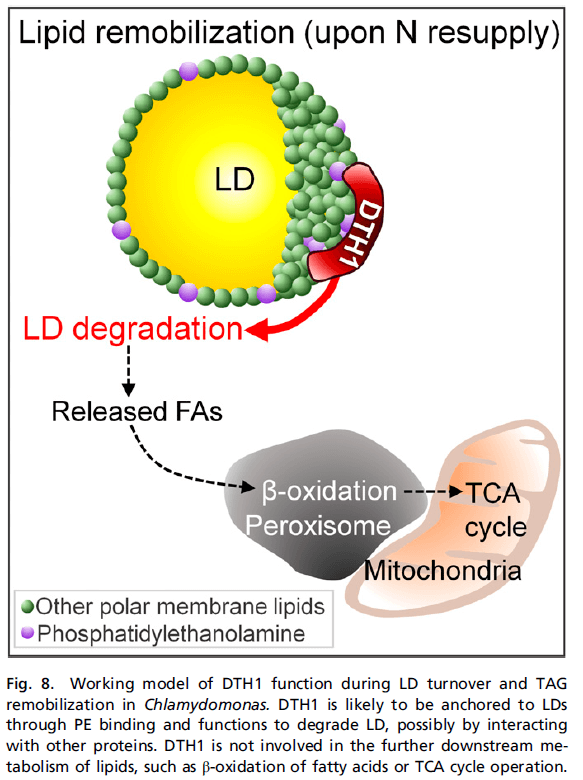
Lipid droplets (LDs) are intracellular organelles found in a wide range of organisms and play important roles in stress tolerance. During nitrogen (N) starvation, Chlamydomonas reinhardtii stores large amounts of triacylglycerols (TAGs) inside LDs. When N is resupplied, the LDs disappear and the TAGs are degraded, presumably providing carbon and energy for regrowth. The mechanism by which cells degrade LDs is poorly understood. Here, we isolated a mutant (dth1-1, Delayed in TAG Hydrolysis 1) in which TAG degradation during recovery from N starvation was compromised. Consequently, the dth1-1 mutant grew poorly compared to its parental line during N recovery. Two additional independent loss-of-function mutants (dth1-2 and dth1-3) also exhibited delayed TAG remobilization. DTH1 transcript levels increased sevenfold upon N resupply, and DTH1 protein was localized to LDs. DTH1 contains a putative lipid-binding domain (DTH1LBD) with alpha helices predicted to be structurally similar to those in apolipoproteins E and A–I. Recombinant DTH1LBD bound specifically to phosphatidylethanolamine (PE), a major phospholipid coating the LD surface. Overexpression of DTH1LBD in Chlamydomonas phenocopied the dth1 mutant’s defective TAG degradation, suggesting that the function of DTH1 depends on its ability to bind PE. Together, our results demonstrate that the lipid-binding DTH1 plays an essential role in LD degradation and provide insight into the molecular mechanism of protein anchorage to LDs at the LD surface in photosynthetic cells.
Image